
Lorem ipsum dolor sit amet consectetur adipisicing elit eiusmod tempor incididunt ut labore et dolore magna aliqua ut enim ad minim veniam quis nostrud exercitation ulla

Quick Answer:
| BPO providers protect customer data through layered security controls, strict access management, encryption, employee training, continuous monitoring, secure infrastructure, and established compliance frameworks. Reliable providers combine technology with documented processes to reduce unauthorized access, prevent data leakage, detect threats, and respond quickly to incidents. The strongest programs treat customer information as a business risk requiring continuous protection and oversight. |
Outsourcing gives businesses access to specialized talent, scalable operations, and potentially lower operating costs. Businesses exploring these advantages can also learn how rapid scalability and operational efficiency make outsourcing a strategic growth driver. However, it can also mean allowing an external organization to access customer records, internal systems, payment information, support conversations, or other sensitive business data.
That makes Data Security a central part of any outsourcing relationship.
The risk depends heavily on the outsourced function. A customer service provider may access names, email addresses, account histories, and support tickets. Understanding what outsourced customer support is can help businesses better evaluate the responsibilities and security requirements involved. A payment support team may interact with payment information. Healthcare outsourcing can involve protected health information. Finance operations may expose invoices, bank details, and confidential corporate records.
A capable Business Process Outsourcing provider therefore builds security into the entire data lifecycle, from the moment information enters its environment until it is archived or securely deleted.

The exact information depends on the outsourced process.
| BPO Function | Information Potentially Handled |
| Customer Support | Names, emails, phone numbers, account histories |
| Finance and Accounting | Invoices, financial records, transaction details |
| Technical Support | Account information, device details, support logs |
| Healthcare Support | Patient and healthcare information |
| Sales Operations | CRM records, leads, contact information |
| Payment Support | Payment and transaction information |
| HR Outsourcing | Employee records, payroll and employment information |
Because different information creates different risks, mature providers classify data according to sensitivity and apply appropriate controls rather than protecting every dataset identically.
Strong information security depends on layers. No single password, firewall, certification, or monitoring system can provide complete protection.
One of the simplest security principles is also one of the most important: employees should only access information required to perform their jobs.
Business Process Outsourcing providers can use role-based access control to determine which systems, applications, records, and functions each employee can access.
For example, a customer service representative handling order questions may need access to order history but not payroll information or complete payment credentials.
The principle of least privilege limits users to the minimum access necessary for their responsibilities.
When an employee changes roles or leaves the organization, access privileges should be reviewed or revoked promptly. Regular access audits also help identify unnecessary permissions before they create security weaknesses.
Passwords alone provide limited protection, especially when credentials are stolen through phishing or reused across services.
Multi-factor authentication adds another verification requirement before granting access. Depending on the environment, this might involve an authentication application, security key, biometric verification, or another approved method.
Combined with strong identity and access management, MFA makes stolen credentials less useful to attackers.
Encryption helps protect information both while it travels between systems and while it is stored.
Secure communication protocols help prevent information from being intercepted while moving between BPO systems, client platforms, cloud environments, or other authorized destinations.
Stored databases, backups, files, and other sensitive repositories can also be encrypted. If storage is compromised, properly implemented encryption can make exposed information significantly more difficult to use without the appropriate keys.
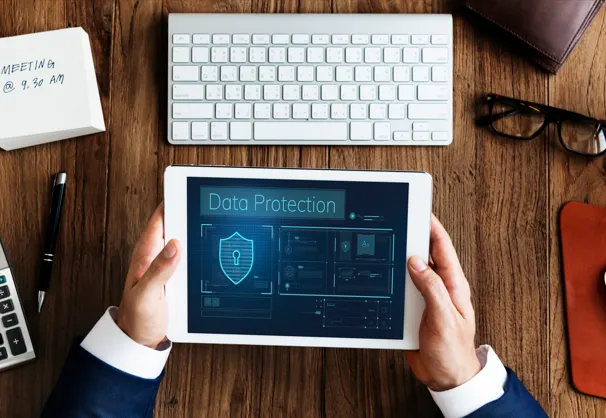
BPO environments often contain hundreds or thousands of endpoints, making device security essential.
Providers may use firewalls, endpoint detection and response tools, anti-malware protection, network segmentation, secure configuration policies, patch management, and intrusion detection technologies.
Network segmentation can be particularly valuable because it separates systems and environments. If one area is compromised, segmentation can help limit an attacker’s ability to move freely into other sensitive systems.
Security does not end after controls are installed.
BPO security teams should continuously monitor systems for suspicious activity, unusual login attempts, unauthorized access, malware, unexpected data transfers, and other indicators of compromise.
Centralized logging and security monitoring can help teams identify patterns that an individual employee might never notice.
The goal is not merely preventing every possible incident. It is also detecting suspicious activity early enough to contain the damage.
Certifications and frameworks give organizations structured methods for managing security and, in some cases, independent assurance that controls have been assessed. However, requirements vary by provider, industry, jurisdiction, and the type of information processed.
| Standard or Framework | Primary Focus | Particularly Relevant For |
| ISO/IEC 27001 | Information Security Management Systems | BPO operations handling sensitive information |
| SOC 2 | Controls related to trust services criteria | Technology and service organizations |
| PCI DSS | Payment account data protection | BPOs handling payment card environments |
| NIST CSF 2.0 | Cybersecurity risk management | Organizations building cybersecurity programs |
| HIPAA | Protected health information | U.S. healthcare-related outsourcing |
| GDPR | Personal data and privacy | Organizations processing covered EU personal data |
Selecting a provider should involve more than reviewing pricing and service capabilities.
Security due diligence should examine how the provider actually protects your information.
Ask questions such as:
Documentation matters. A provider should be able to support important security claims with relevant policies, reports, certificates, contractual commitments, or other appropriate evidence.

Outsourcing a process does not automatically outsource every associated risk.
Clients still need to decide what information the provider receives, configure appropriate permissions, establish contractual requirements, review provider performance, and maintain internal governance.
Meanwhile, the provider must operate the controls, systems, employees, and processes it has committed to maintaining.
Successful Business Process Outsourcing relationships therefore depend on clearly defined responsibilities between both parties.
Strong Data Security is not achieved through one certification or piece of software. It comes from combining governance, employee awareness, identity controls, encryption, secure infrastructure, monitoring, incident preparedness, and regular improvement.
Before signing an outsourcing agreement, businesses should understand exactly what information will leave their direct environment and how that information will be protected throughout its lifecycle.
The best BPO relationships make security measurable, documented, and transparent. When clients and providers establish clear responsibilities from the beginning, outsourcing can deliver operational benefits without treating customer trust as an afterthought.
| Related Blogs: How Strategic BPO Drives Real Cost Optimization; Prioritizing Data Security in Modern Help Desk Environments |
BPO providers protect customer information using encryption, access controls, secure networks, multi-factor authentication, employee training, and continuous monitoring. They also establish strict security policies, regularly assess potential vulnerabilities, and follow recognized standards to reduce unauthorized access and potential data breaches.
Reliable BPO providers commonly follow recognized frameworks such as ISO 27001, SOC 2, PCI DSS, and NIST cybersecurity guidelines. Depending on their industry and location, providers may also need to comply with privacy regulations such as GDPR or healthcare requirements like HIPAA.
ISO 27001 provides a structured framework for managing information security risks across an organization. For BPO companies handling sensitive client information, certification demonstrates that documented security controls, risk management processes, continuous improvement practices, and information protection responsibilities have been formally established and assessed.
Businesses should review security certifications, independent assessments, access controls, encryption practices, employee training, incident response procedures, and data retention policies. They should also ask how providers manage subcontractors, monitor suspicious activity, conduct security testing, and securely delete information when outsourcing agreements eventually end.
A prepared Business Process Outsourcing provider follows an established incident response plan to identify, contain, investigate, and resolve the security event. Depending on contractual and regulatory requirements, affected clients and authorities may receive notifications while recovery procedures restore systems and strengthen controls against similar incidents.

© 2025 Vertical Edge Limited | All Rights Reserved